El Castillo: Ancient Maya Pyramid Engineering Revealed by Modern Technology
BY CLIFF DUNNING
I’ve mentioned often on the Earth Ancients podcast, and in my writing, that I have a fascination with pyramids, particularly those of the ancient Maya. I’ve climbed them, walked through their passageways, studied their construction, and wondered why ancient people invested such enormous amounts of labor and resources into building them. One of my favorites stands at Chichén Itzá in Mexico’s Yucatán Peninsula, where the great, stepped pyramid commonly known as El Castillo dominates the center of the archaeological acropolis.
I remember fondly the first time I set eyes on El Castillo, or “the Castle,” in 1996. Closely associated with Kukulcán, the Maya feathered-serpent deity, the pyramid rises approximately 30 meters (98 feet), including its summit temple, from a square base measuring roughly 55 meters (180 feet) on each side. The entrance to the summit temple is framed by two columns.
Until 2006, visitors were permitted to climb El Castillo, aided by a heavy chain secured near the summit and draped down the main staircase. I had the opportunity to make that climb many times. The staircase rises at approximately 45 degrees, ascending roughly 24 meters (79 feet) to the upper platform. The chain provided balance, but the climb was deceptive. Reaching the summit was one thing; coming back down while looking over that steep staircase was another. Many visitors descended cautiously, gripping the chain for stability. The experience left me with the distinct impression that this staircase was never designed for casual movement. Its imposing ascent was more likely intended for a select group—rulers, priests, astronomers, or other members of the Maya elite.
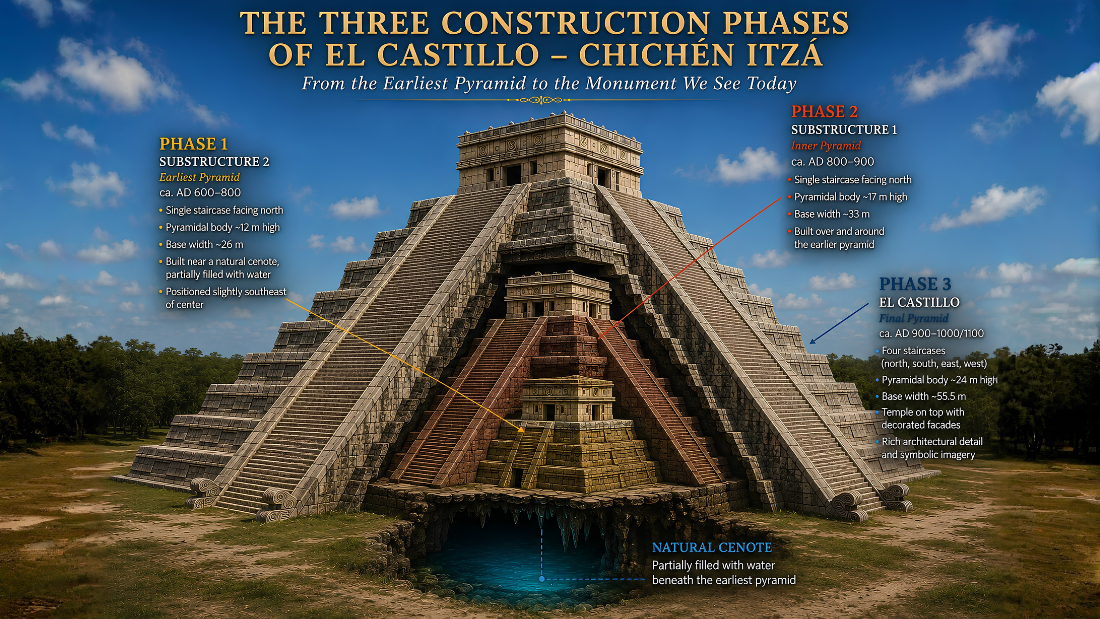
Over the decades archaeologists discovered that inside El Castillo are the remains of earlier pyramids, one constructed over another, and beneath this architectural sequence lies a cenote, an underground water-filled cavity. Over the past century, archaeological excavation followed by increasingly sophisticated imaging technology has gradually changed our understanding of this extraordinary monument. El Castillo can no longer be viewed simply as a single pyramid constructed during one period of Maya history. Three major structures have now been identified, preserving different stages of construction like architectural time capsules.
Opening the Pyramid
Modern archaeological investigation of El Castillo began in earnest during the early twentieth century. In the 1930s, researchers working with the Carnegie Institution of Washington, with authorization from the Mexican government, began exploring and restoring Chichén Itzá. As archaeologists investigated El Castillo, they discovered that the visible pyramid concealed an earlier pyramid within it. This was not unusual in Mesoamerica, where successive generations frequently constructed new temples and pyramids over earlier buildings. Instead of demolishing a sacred structure and beginning again, builders could incorporate it into a larger monument, with the earlier building becoming the core of the next.
The second structure is substantially smaller than the El Castillo we see today but still represents a considerable architectural undertaking. Approximately 33 meters (108 feet) across its base and about 20 meters (65 feet) high, including its upper temple, it possesses its own staircase and summit sanctuary. It was not simply a foundation for the later El Castillo but a functioning pyramid that was eventually encased within the much larger monument visible today.
El Castillo may therefore represent centuries of construction, modification, and rebuilding. Different generations could expand and reinterpret the same sacred location while preserving much of the architecture that came before them. Investigators eventually created a passage through the outer pyramid that allowed access to this earlier structure, sometimes identified as Substructure II.
I had an opportunity to enter that passage in 1997, and it remains one of my strongest memories of Chichén Itzá. Within the earlier temple, archaeologists discovered some of the most famous objects associated with the site, including the red jaguar throne and a Chac Mool figure. For decades, this inner pyramid seemed to provide a relatively straightforward history: the great outer pyramid had been constructed over an earlier version. Modern technology has now complicated that picture considerably.
A Third Pyramid Temple Detected
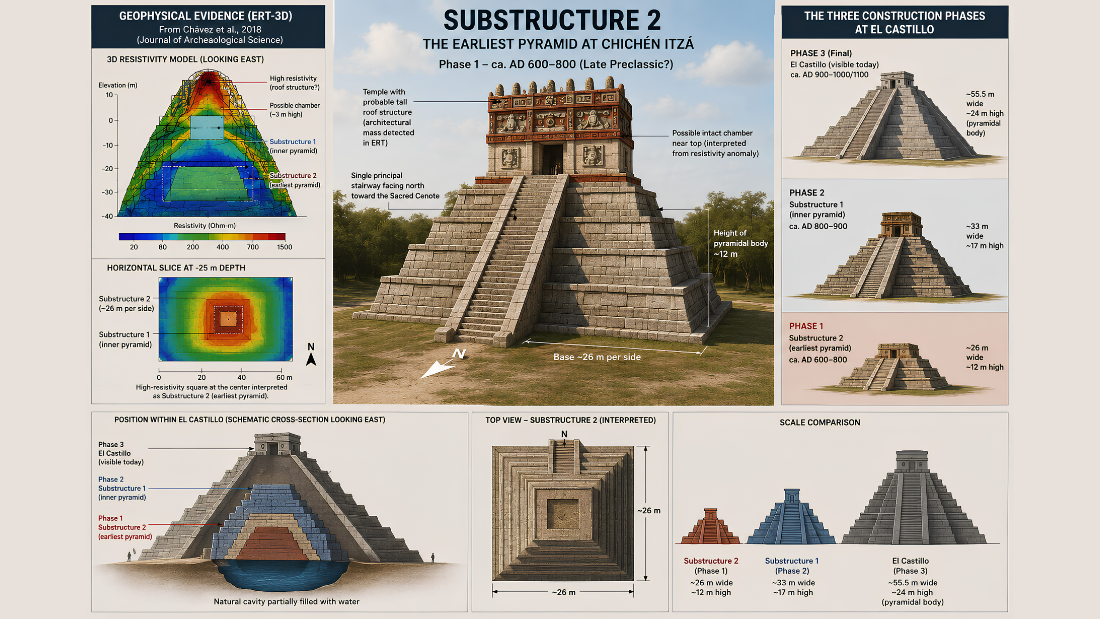
A major breakthrough came with the application of Electrical Resistivity Tomography, or ERT, which allowed scientists to investigate the interior without excavating another network of tunnels. Rather than functioning like a conventional photograph or X-ray, electrical tomography introduces electrical current through electrodes positioned around a structure and measures variations in resistance. Limestone, construction fill, cavities, saturated areas, and other materials can produce contrasting electrical signatures, allowing researchers to construct a three-dimensional model of what cannot physically be seen.
The results were remarkable. Electrical resistivity differences identified the already-known interior pyramid, demonstrating that the technology could detect a structure whose location archaeologists understood. More importantly, the imaging revealed another resistive feature deeper inside. Researchers concluded that the data provided evidence for a still earlier and smaller structure at the center of El Castillo.
This third structure, now considered the earliest known pyramid in the sequence, is considerably smaller than those surrounding it. A 2017 scientific analysis estimated it at approximately 23 meters (75 feet) along each side of its base and about 10 meters (33 feet) high. The imaging also indicated what may be an intact rectangular chamber approximately 3 meters (10 feet) high near its summit. If that interpretation is correct, this was not simply an irregular mass of earlier construction buried beneath El Castillo. It appears to have been another deliberately constructed pyramidal building with an upper chamber or temple. Its importance lies partly in its position at the beginning of the architectural sequence. Later Maya builders inherited a location that was already monumental and presumably sacred. The builders of this earliest known structure did not. Something drew them to this particular place.
That becomes more interesting when we look beneath the pyramid. An earlier phase of the electrical resistivity investigation, conducted in 2014 and reported in 2015, detected a natural cavity, likely a cenote, beneath El Castillo that appears to be partially filled with freshwater. The Yucatán Peninsula is riddled with underground cavities, rivers, and cenotes created as water moves through its limestone geology. Chichén Itzá itself is closely associated with water; its name is generally translated in connection with the “well of the Itzá,” while the great Sacred Cenote north of the ceremonial center played an important role in the history of the site.
Was the relationship between the earliest pyramid and the water beneath it accidental? We cannot yet answer that question, but its presence adds another dimension to the origins of El Castillo.
Water Beneath Sacred Architecture
For me, the water beneath El Castillo may ultimately prove to be one of the most intriguing parts of the story. Archaeologist Ed Barnhart has discussed the importance of water management in ancient Maya cities, particularly at Palenque, where Maya engineers constructed sophisticated systems for directing water through and beneath portions of the city. Similar systems appear elsewhere in Mesoamerica, including Teotihuacan, where elaborate drainage and water-management networks were incorporated into monumental architecture.
Clearly, water was not simply something ancient builders encountered; in many places, they deliberately controlled and integrated it into their architectural landscapes. This raises an important question at El Castillo: was the earliest pyramid intentionally positioned above the underground water source? We have archaeological evidence for multiple phases of construction and geophysical evidence for water beneath the monument, but no surviving Maya text explaining why these elements were brought together. Until such evidence emerges, the connection remains speculative—but the relationship between water and monumental architecture elsewhere in Mesoamerica makes it a question worth asking.
A Sacred Science?
This leads to a more controversial possibility that I explore in my forthcoming book, The Maya Controversy. Could Maya builders have understood properties of the natural environment that went beyond construction and water management? Researcher John Burke investigated ancient monuments in several parts of the world and proposed that some locations exhibited unusual electromagnetic or geophysical characteristics. Others have similarly questioned whether ancient builders deliberately selected certain locations because of naturally occurring telluric properties within the landscape.
El Castillo provides an intriguing place to consider the possibility. Water moving through limestone beneath a massive stone structure can produce measurable geophysical effects. The more difficult question is whether Maya builders recognized such effects and deliberately incorporated them into their architecture. There is presently no evidence demonstrating that they did, but the question becomes more interesting when considered alongside what we already know about Maya observational abilities.
The Maya were extraordinary observers of their environment. Their astronomers tracked the movements of the Sun, Moon, Venus, and other celestial phenomena across long periods of time. Their architects demonstrated sophisticated knowledge of orientation, acoustics, water management, and the behavior of light and shadow. None of this proves that the builders of El Castillo were manipulating naturally occurring Earth energies. It does, however, remind us not to underestimate the sophistication with which Maya specialists observed the natural world.
The Original Intent of El Castillo
Ultimately, the deepest question surrounding El Castillo may be the simplest: why here? The outer pyramid reflects generations of rebuilding, but the smallest and earliest structure takes us closer to the original decision. Was the site selected because of the water beneath it, its relationship to the surrounding landscape, astronomical considerations, or something we have yet to understand? We simply do not know.
Modern imaging cannot answer that question, but it gives us something earlier generations of archaeologists did not have: the ability to examine El Castillo from the inside out without dismantling it. As the technology improves, the most important discovery may not be another chamber or hidden passage, but evidence that helps explain why Maya builders chose this particular place and why generations that followed continued to build upon it. Perhaps the greatest secret within El Castillo is not what remains hidden inside the pyramid, but what its builders originally intended.