El Caracol and the Problem of What We Think We See
BY CLIFF DUNNING
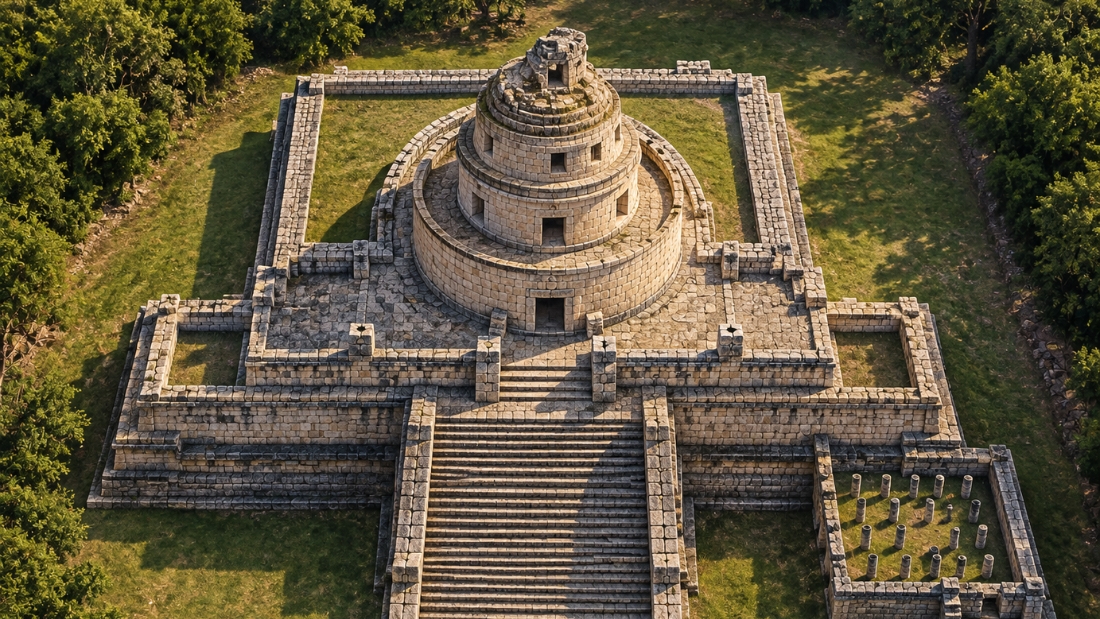
El Caracol at Chichén Itzá is one of the best examples of why Maya architecture can be misleading when judged only by what survives on the surface. The ruin seen today is not simply a damaged version of a single building. Karl Ruppert’s 1935 investigation showed that the monument developed through a sequence of construction phases in which earlier architecture was enlarged, buried, enclosed, and reused. His work documented a first circular platform, a second circular platform surrounding it, and later rectangular additions that progressively enclosed the circular structure.
That sequence is important for The Maya Controversy because it changes the way the building should be interpreted. The deep curved openings visible today beside the circular tower can easily be mistaken for deliberately exposed shafts or channels in the original design. Ruppert’s excavation record points to a more complicated explanation. He describes trenches cut around the earlier circular platform so its facing could be examined, after which most of the excavation was refilled while selected areas were left exposed. What we see today is therefore partly the architecture of the Maya and partly the result of archaeological investigation.
The completed reconstruction attempts to reverse that process. Instead of presenting the monument in its excavated condition, it restores the later rectangular platform over the earlier circular phases. This produces a much cleaner exterior than the modern ruin suggests: a broad rectangular platform supporting a circular tower whose earlier construction stages were largely hidden beneath later masonry.
The tower itself remains the most unusual part of the structure. Ruppert documented two annular chambers surrounding a massive central masonry core. Inside that core was a narrow spiral passageway containing a staircase that ascended toward the second story. Ruppert specifically describes the opening into this passage and states that the stairway evidently led upward to the second level. This was not an exposed ceremonial stair curling around an open shaft. It was an internal architectural feature embedded within a dense masonry core.
The upper story is where El Caracol becomes particularly significant to the argument developed in The Maya Controversy. Ruppert found recessed windows and narrow shafts whose surviving stones were still in place. He concluded that the shafts and an associated upper passageway were “apparently for observational purposes.” His publication even includes a suggested original section through the tower windows and a plan showing the shafts with their true bearings.
That evidence is important, but it should not be pushed further than Ruppert did. El Caracol can reasonably be described as a building containing architectural features associated with observation. It is much harder to prove precisely what celestial events were being measured, what instruments may have been used, or how sophisticated the observational program was. Those questions belong in the category of interpretation rather than established archaeological fact.
This distinction is central to the larger argument of The Maya Controversy. The Maya repeatedly built complex systems whose most important features are not always visible in the surviving exterior. Water systems can run beneath plazas. Earlier temples can disappear inside later pyramids. Stairways, shafts, chambers, vents, and passages may be completely concealed within masonry. El Caracol demonstrates this principle particularly well.
It also raises a larger question. The final building represents more than an isolated architectural experiment. Successive generations preserved the circular plan, expanded it, buried earlier elements rather than simply destroying them, and eventually created an upper structure containing specialized passages and shafts. That suggests continuity of planning and accumulated technical knowledge.
For the book, El Caracol therefore should not be presented as proof of an unknown technology. Its value is stronger than that. It is documented evidence that Maya builders were capable of integrating geometry, structural engineering, concealed circulation, multiple construction phases, and apparently observational architecture into a single monument. The controversy begins not with claiming more than the evidence shows, but with asking whether we have fully appreciated what the evidence already demonstrates.